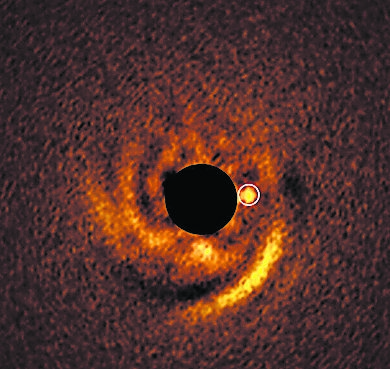
In a glimpse of what the Earth looked like 4.5 billion years ago, astronomers have spotted a newborn planet in its earliest days of infancy forming within a spiral of dust for the first time.
“We will never witness the formation of Earth but here, around a young star 440 light years away, we may be watching a planet come into existence in real time,” Francesco Maio, a researcher at the University of Florence in Italy, said.
Astronomers used the European Southern Observatory’s Very Large Telescope in Chile, turning its gaze on a young host star called HD 135344B.
Around the star they spotted a disc of dust that fanned out with spirallike arms, similar to the shape of the Milky Way.
Embedded at the base of one of these spiral arms they spotted a proto-planet, a bundle of rocks and dust that has started to coalesce to form a planet. It is already estimated to be twice the size of Jupiter and about the same distance from its star as Neptune is from the Sun, or about thirty times the distance between the Earth and the Sun. Such discs have been spotted around stars before and astronomers have long thought that their patterns, containing spirals, rings or gaps, were caused by nascent planets but they had never spotted an infant planet in the process of carving out patterns in the dust.
“What makes this detection potentially a turning point is that, unlike many previous observations, we are able to directly detect the signal of the protoplanet, which is still highly embedded in the disc,” said Maio, who works at the Arcetri Astrophysical Observatory and led the research, which was published in the Astronomy & Astrophysics journal.
“This gives us a much higher level of confidence in the planet’s existence, as we’re observing the planet’s own light.”
In a second study published yesterday, astronomers have also discovered that one of the most famous stars in the night sky, Betelgeuse in the constellation of Orion, has an extremely dim “companion” star that is orbiting around it, potentially solving a millennia-old mystery over why the brightness of Betelgeuse seems to fluctuate.
In this case, astronomers used an instrument on the Gemini North telescope in Hawaii called Alopeke to examine Betelgeuse, which is one of the brightest stars in the sky.
It is only ten million years old, one 450th the age of our Sun, but it is thought to be close to the end of its life and already in its red supergiant phase, meaning that it is likely to explode in a spectacular supernova in the next few tens of thousands of years.
For millennia, stargazers have noticed that the brightness of Betelgeuse fluctuates in a regular cycle and some suggest that there may be a second, much dimmer star in orbit around Betelgeuse that periodically blocks some of its light.
This fabled second star has finally been detected by researchers at the Nasa Ames Research Center, led by Steve Howell. The study, published in the Astrophysical Journal Letters, found that it is about 1.5 times the mass of our Sun, but is far dimmer than Betelgeuse and likely to be spiralling inwards to collide with it in a fiery death within the next 10,000 years.
“Papers that predicted Betelgeuse’s companion believed that no one would likely ever be able to image it,” Howell said.


No comments:
Post a Comment