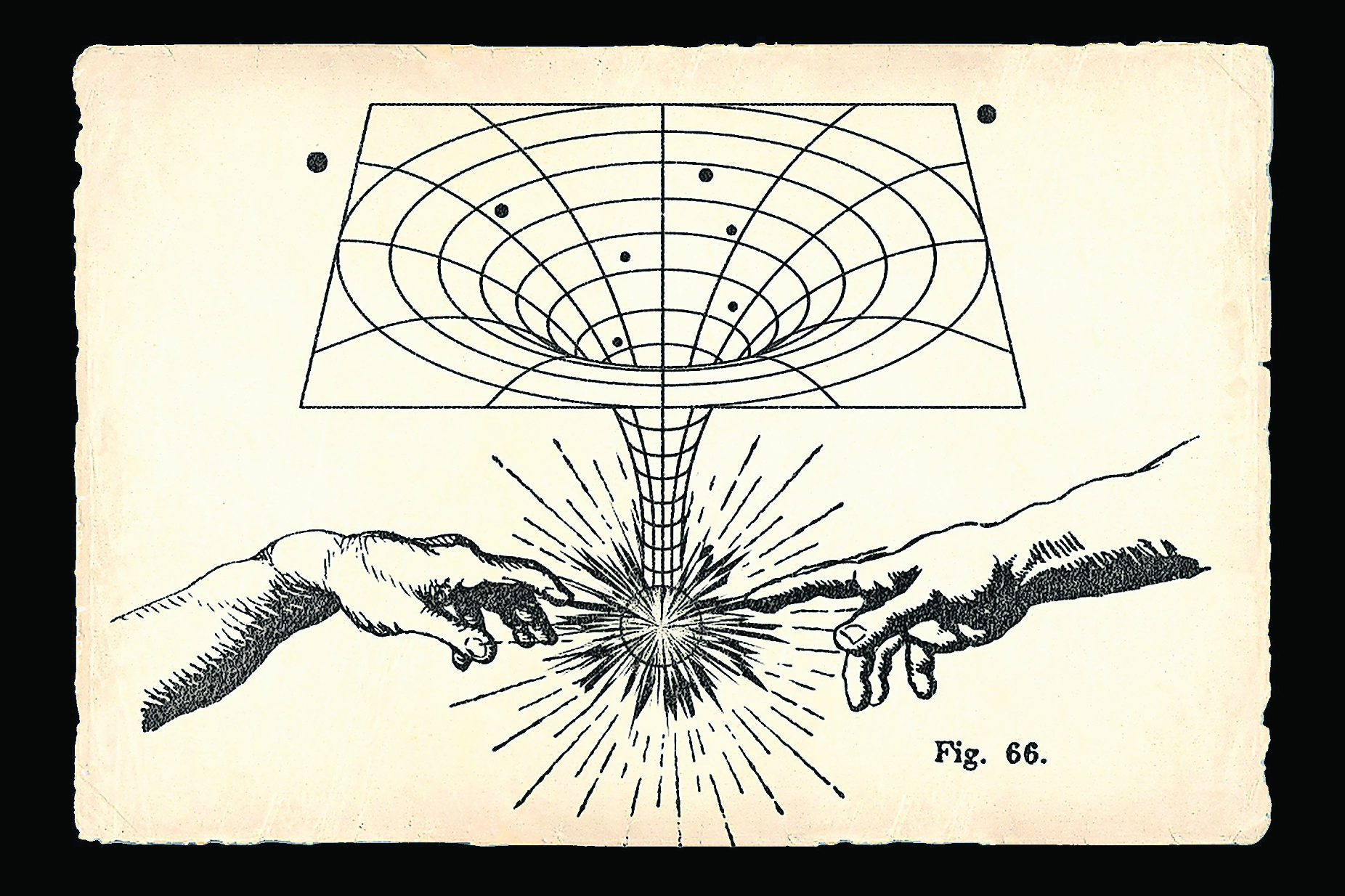
Science and religion have never been easy bedfellows. As Thomas Jefferson put it in 1820, priests “dread the advance of science as witches do the approach of daylight”. Five centuries of scientific breakthroughs — from Galileo to Darwin to Crick and Watson — have eroded our belief in the divine.
But now, according to a new book, a “great reversal” is under way. Science, its authors argue over 580 pages, has come full circle and “forcefully put the question of the existence of a creator God back on the table”.
In a striking challenge to the academic consensus, two French authors, Michel- Yves Bolloré and Olivier Bonnassies, argue that the latest scientific theories lead to only one logical conclusion: an all-powerful deity created the universe and all life within it.
Their argument has already gained traction. The French edition of their book God, the Science, the Evidence, published in 2021, and subsequent translations in Spanish, Italian and Portuguese, have sold more than 400,000 copies. The English edition, which will be published next week, has had an initial print run of 110,000.
Readers have long sought answers about their origins. Richard Dawkins’ The God Delusion has sold more than three million copies. Stephen Hawking’s A Brief History of Time has sold 25 million. The Bible is the bestselling book of all time, with an estimated seven billion copies printed.
These authors — like Dawkins and Hawking — consider themselves men of science. Bolloré, 79, from Brittany, is a computer engineer who has founded a series of successful heavy industry, engineering and mechanical firms; Bonnassies, 59, from Paris, studied science and maths before a career as an entrepreneur in the French media industry.
Both are also men of faith. Bolloré is a lifelong Catholic. Bonnassies, who did not find his Christian faith until his twenties, said he thought before his conversion that “believers were irrational people”, adding: “God, the Resurrection, the Virgin Mary — I found it crazy.” Yet it was logic, he said, that won him around: “The surprise was there were many rational reasons to believe in God.”
Despite their beliefs, they insist their book is not about spirituality. Bolloré, who has lived in west London for the past 15 years, said: “This is not a book about faith or religion. Who God is, what does he want, what does he think, what does he say: that’s very interesting, but it’s a question of religion. That’s not what this book is about.”
Instead, the authors have written a critique of materialism — the theory that all reality, including our origins, thoughts and consciousness, can be explained solely by physical matter and physical processes. The materialist narrative for the beginnings of the universe and life on earth is so full of holes, he and Bonnassies argue, that every scientific advance increases the strength of the case that a “creator” is the only rational explanation.
The authors’ ideas have received support from unexpected quarters. The renowned physicist Robert Wilson, who was jointly awarded the Nobel prize in physics for the discovery of cosmic microwave background radiation, agreed to write the foreword to the book. “Although the general thesis ... that a higher mind could be at the origin of the universe does not provide a satisfying explanation for me, I can accept its coherence,” he wrote. “If the universe had a beginning, then we cannot avoid the question of creation.”
Their book explores key theories such as the Big Bang, the theory of relativity, quantum mechanics and the human genome. Each detail was checked with a group of leading scientists to ensure the arguments could not be challenged on the basis of scientific inaccuracy.
Their conclusions pose a fundamental challenge to the orthodoxy underpinning modern science. For the past century, for example, scientists have known the universe is expanding. If stars and galaxies are always moving further apart, logic dictates, the universe must have started at a single point, in a state of immense density. In 1931 the Belgian theoretical physicist Georges Lemaître termed this the “primeval atom”. We now call it the Big Bang.
But if all matter originates from that single explosion, and materialism dictates there is nothing outside of matter, what caused the bang?
“The theory doesn’t work,” Bolloré said. The laws of motion, he said, lead to the conclusion that there must have been a single beginning, a starting point to all physical existence.
“Nothing is infinite,” he said. “The reasonable mind must hold that our universe has one beginning.” He argues that the only rational explanation for a single point is for something outside the material world, an external being that could have started it — a creator God.
Another key mystery that can be explained only by the existence of some universal God, the authors argue, is the start of life. “DNA appeared on earth 3.8 billion years ago, and it was a technological marvel,” said Bonnassies. “All living beings on earth: bacteria, human beings, plants, animals — they are all coded by this same DNA.”
According to the theory of evolution, this incredibly sophisticated data storage system emerged from the primordial soup by chance. The authors write: “While we still do not know how that gap was bridged, or a fortiori, how to replicate such an event, we do know enough to appreciate its infinite improbability.”
Bolloré acknowledged that the book does not present proof of God’s existence. “You cannot prove it,” he said. “You have evidence for one theory — the existence of God. And you have evidence for the other one, which is the non-existence of God. The best you can do is to compare the two sides of the scale.”
Bolloré and Bonnassies want a great debate with scientists about their ideas. Last month they held conferences with leading astrophysicists, neuroscientists and philosophers at Princeton and Berkeley in the US, and plan similar events at Oxford and Cambridge.
Bolloré insisted this is not an evangelical project; he is not trying to convert anyone: “I say again, this is not a book about faith or religion.”
But he said a debate about the origins of the universe raises questions about the meaning of life itself, adding: “I think that everybody should ask themselves, at some point in their life, ‘Are we just the result of chance and necessity? Or are we more than that?’”
God, the Science, the Evidence, by Michel-Yves Bolloré and Olivier Bonnassies, will be published by Palomar on October 14 at £22


No comments:
Post a Comment