Tuesday, July 22, 2025

AS25002 Reporting of Lightning Strikes V01 220725

 LightningMaps.org gets its data from a volunteer-run global lightning detection network called Blitzortung.org, which is then visualized on LightningMaps.org. Here’s how it works:


⚡ Lightning Detection & Data Collection

VLF (Very Low Frequency) antennas (3–30 kHz) listen for the radio pulses—“sferics”—emitted by lightning strikes .

Each antenna is precisely located via GPS and timestamps every detected pulse with microsecond accuracy .


From Reddit’s ExplainLikeI’mFive:


“Each of these antennas have their location known by GPS … and triangulates the strike” 

“They use radio waves … precisely measure the time … and use the speed of light … triangulate” 


📍 Triangulating Lightning Locations

The time difference of signal arrival between stations creates hyperbolic curves of possible strike locations .

Once three or more stations detect the same pulse, the system calculates the intersection point to determine the strike location .

Blitzortung.org processes all this in real time, usually within seconds, and shares the lightning event data publicly for the last couple of hours .


🌐 Role of LightningMaps.org

LightningMaps.org is a frontend that takes Blitzortung.org’s data and displays it on interactive maps, often with satellite overlays .

It uses the MyBlitzortung open-source PHP application—also what users install if they want to host their own local maps .

The site periodically polls Blitzortung.org via its API or UDP streams, updates the strike data, filters it, and renders the visual output .


🛠 Behind the Scenes: Data Format & Handling

Raw signal data can be requested as UDP streams or JSON via Blitzortung.org .

This raw data includes station ID, GPS position, nanosecond timestamps, and waveform samples .

LightningMaps.org (using MyBlitzortung) fetches this data every minute or so, computes positions, and updates the maps accordingly .


🧑‍🤝‍🧑 Volunteers & Accuracy

Blitzortung runs on approximately 1,800 volunteer stations in over 80 countries .

Stations are typically spaced 50–250 km apart, giving accuracy often within 1 km, though false readings can occur and strike types aren’t distinguished .


📝 Summary Table


Component Function

Blitzortung.org Collects VLF signals using volunteer antennas, timestamps with GPS, then computes lightning locations via TOA.

LightningMaps.org Fetches Blitzortung data, processes it with MyBlitzortung, and displays it on interactive maps with overlays.


In short:

Data originates from ground-based, GPS-synced antenna stations. Signals are timestamped, sent to central servers, located via triangulation, and then picked up by LightningMaps.org, which maps them in near real-time.


Let me know if you want details on the hardware, data flow, or how to access their raw API!

Monday, July 21, 2025

AS25001 Earth’s Formation V01 220725

Newborn planet gives glimpse into Earth’s formation

Kaya Burgess - Science Correspondent

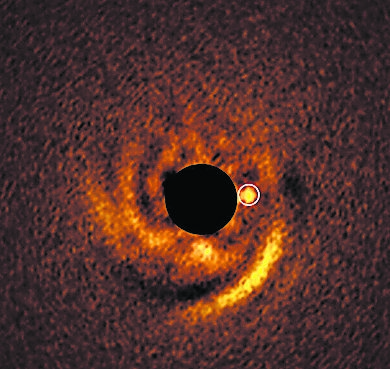
The spiral arms of dust swirl around the proto-planet, circled in white

In a glimpse of what the Earth looked like 4.5 billion years ago, astronomers have spotted a newborn planet in its earliest days of infancy forming within a spiral of dust for the first time.

“We will never witness the formation of Earth but here, around a young star 440 light years away, we may be watching a planet come into existence in real time,” Francesco Maio, a researcher at the University of Florence in Italy, said.

Astronomers used the European Southern Observatory’s Very Large Telescope in Chile, turning its gaze on a young host star called HD 135344B.

Around the star they spotted a disc of dust that fanned out with spirallike arms, similar to the shape of the Milky Way.

Embedded at the base of one of these spiral arms they spotted a proto-planet, a bundle of rocks and dust that has started to coalesce to form a planet. It is already estimated to be twice the size of Jupiter and about the same distance from its star as Neptune is from the Sun, or about thirty times the distance between the Earth and the Sun. Such discs have been spotted around stars before and astronomers have long thought that their patterns, containing spirals, rings or gaps, were caused by nascent planets but they had never spotted an infant planet in the process of carving out patterns in the dust.

“What makes this detection potentially a turning point is that, unlike many previous observations, we are able to directly detect the signal of the protoplanet, which is still highly embedded in the disc,” said Maio, who works at the Arcetri Astrophysical Observatory and led the research, which was published in the Astronomy & Astrophysics journal.

“This gives us a much higher level of confidence in the planet’s existence, as we’re observing the planet’s own light.”

In a second study published yesterday, astronomers have also discovered that one of the most famous stars in the night sky, Betelgeuse in the constellation of Orion, has an extremely dim “companion” star that is orbiting around it, potentially solving a millennia-old mystery over why the brightness of Betelgeuse seems to fluctuate.

In this case, astronomers used an instrument on the Gemini North telescope in Hawaii called Alopeke to examine Betelgeuse, which is one of the brightest stars in the sky.

It is only ten million years old, one 450th the age of our Sun, but it is thought to be close to the end of its life and already in its red supergiant phase, meaning that it is likely to explode in a spectacular supernova in the next few tens of thousands of years.

For millennia, stargazers have noticed that the brightness of Betelgeuse fluctuates in a regular cycle and some suggest that there may be a second, much dimmer star in orbit around Betelgeuse that periodically blocks some of its light.

This fabled second star has finally been detected by researchers at the Nasa Ames Research Center, led by Steve Howell. The study, published in the Astrophysical Journal Letters, found that it is about 1.5 times the mass of our Sun, but is far dimmer than Betelgeuse and likely to be spiralling inwards to collide with it in a fiery death within the next 10,000 years.

“Papers that predicted Betelgeuse’s companion believed that no one would likely ever be able to image it,” Howell said.

AS25005 Possible Aliens - 3I/ATLAS V01 201225

  31 ATLAS (more properly referred to as 3I/ATLAS ) is an interstellar object — a body from outside our solar system that passed through ...