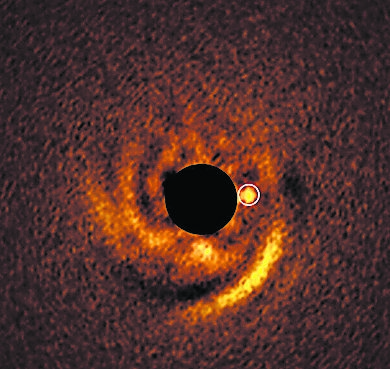
31 ATLAS (more properly referred to as 3I/ATLAS) is an interstellar object — a body from outside our solar system that passed through it — and has been the focus of intense astronomical observation and public interest in 2025.
🌌 What It Is
• 3I/ATLAS is classified as the third confirmed interstellar object observed entering our solar system, following ‘Oumuamua and 2I/Borisov.
• The “ATLAS” part of the name comes from the Asteroid Terrestrial-impact Last Alert System — a survey telescope network that detected it in July 2025.
• It’s called 3I/ATLAS because “3I” denotes the third interstellar object ever recorded.
🪐 Key Scientific Details
• Origin: It came from outside the solar system on a hyperbolic trajectory, meaning it isn’t gravitationally bound to the Sun and will leave again.
• Speed and Motion: It’s moving extremely fast — on the order of tens of kilometers per second — typical of interstellar visitors.
• Composition and Appearance:
• Observations show it has a coma (a diffuse envelope of gas and dust) and a tail, signs it behaves like a comet.
• Unusual features include a high proportion of carbon dioxide and trace amounts of nickel in the coma — chemistry that differs from many comets from within our solar system.
• Size: Estimates vary, but the nucleus is likely a few kilometers across, making it larger than some known interstellar objects.
🔭 Observations & Timeline
• It reached its closest point to the Sun (perihelion) around October 30, 2025.
• It passed relatively near Mars in early October, enabling additional observations from spacecraft orbiting the Red Planet.
• In December 2025, it made its closest approach to Earth (still very distant, about 168–170 million miles), giving astronomers a rare window for study.
🧪 Why It Matters
• Interstellar objects like 3I/ATLAS offer a unique scientific opportunity to study material formed around other stars and compare it with our own solar system’s building blocks.
• Tracking such objects improves understanding of comet behavior and informs planetary defense techniques for future encounters.
🛸 Speculation vs. Science
• Some speculative claims, including by Harvard astrophysicist Avi Loeb, have suggested unusual behaviors or even an artificial (alien) origin. These ideas have gained media attention but are not supported by mainstream scientific evidence. Most astronomers view 3I/ATLAS as a natural interstellar comet.
• Space agencies like NASA and ESA have emphasized that the object poses no threat to Earth and behaves like a comet, though with interesting anomalies worth studying.
In short: 31 ATLAS (3I/ATLAS) is a fascinating interstellar comet passing through our solar system — a rare event that is helping scientists learn about materials and conditions from other star systems, while also inspiring public curiosity and scientific debate.
Would you like a current sky map showing where 31 ATLAS is visible from Earth right now? (I can generate one.)